


📊 The System That Was Designed to Catch Fraud — And Ended Up Punishing Families
Across the world, governments are turning to automation to make welfare systems more efficient, reduce fraud, and improve targeted public benefits.
On paper, this looks like good governance.
In practice, automation can quietly change how the state relates to its citizens — especially when systems are designed primarily to detect wrongdoing rather than protect legitimate beneficiaries.
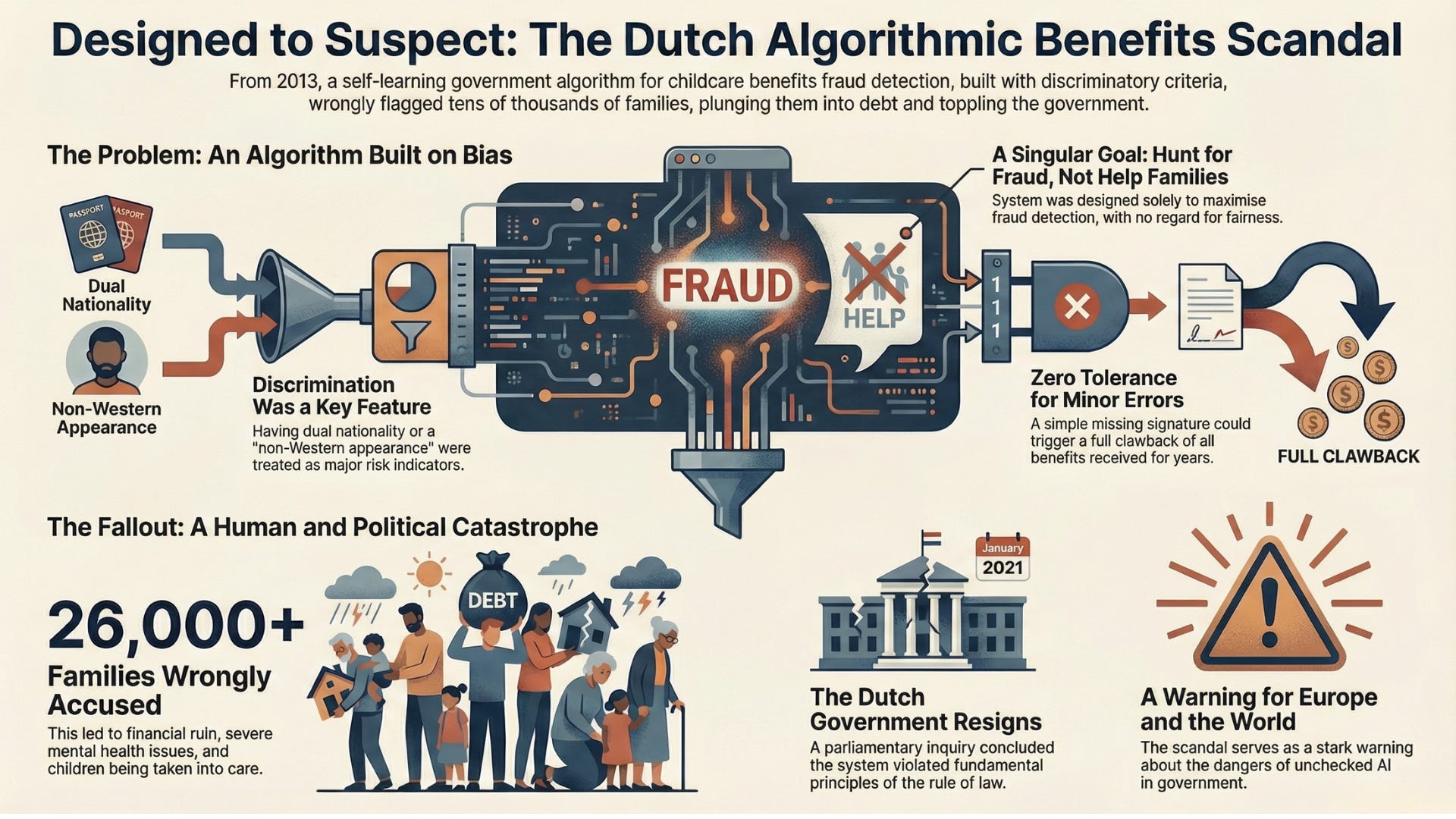
For more than a decade, an automated risk system within the Dutch childcare benefits program contributed to one of the most serious governance failures in modern European public administration.
The Dutch childcare benefits program falsely accused around 26,000 families of fraud, forced them to repay large sums, and plunged them into a financial and social crisis.
The scandal ultimately forced the resignation of the entire Dutch government in 2021.
This problem was not a case of AI behaving unpredictably.
It was a case of governance choices being translated into a system design— and then executed at scale.
📖 When Welfare Systems Start Treating Suspicion as Evidence
The system was built during a period of intense political pressure to reduce welfare fraud. Automation was considered the solution: faster detection, consistent enforcement, and reduced administrative burden.
But the system’s core objective was fundamentally one-sided: catch as many suspected fraud cases as possible.
What it was not optimised for:
Minimising false accusations
Protecting vulnerable families
Ensuring proportional response
Preserving due process
When those balancing objectives are missing at the design stage, the technology simply scales institutional bias with efficiency and authority.
🎥 Explainer: How the Dutch Welfare Algorithm Created Systemic Harm
[Netherlands Child Welfare Scandal Video]
🔍 The Failure Happened Before Deployment — Not After
Most AI governance discussions focus on:
Model accuracy
Explainability
Bias audits
Post-deployment monitoring
The Dutch case shows something more uncomfortable.
Catastrophic harm can be locked in before a single prediction is made, when policy goals are translated into system objectives.
If you build a system to aggressively detect fraud without equally weighting false harm, you are not building neutral technology.
You are building automated suspicion infrastructure.
And once deployed, it scales without hesitation.
🌍 Why This Case Matters Far Beyond Europe
If a failure of this magnitude can happen in a wealthy, institutionally strong European country, policymakers everywhere need to ask harder questions.
For countries that are rapidly digitising public services, the risks can be even more severe:
Citizens may rely more heavily on state benefits
Appeals systems may be slower or harder to access
Data may be more fragmented or incomplete
Historical social biases may be easier to encode into automated rules
Automation does not remove institutional bias.
It can industrialise it.
👉 In the Full Analysis
I break down:
• How policy pressure translated into flawed system objectives
• How discriminatory signals were encoded into risk modelling
• How governance oversight failed across the lifecycle
• What this means for future AI use in welfare, taxation, and credit systems
👉 Read the full case analysis here:
[The Netherlands Child Welfare Scandal — globalsouth.ai]
👉 Download the Netherlands Fairness Case Deck (PDF)
The Real Lesson
The Dutch childcare scandal is often described as an AI failure.
It is more accurately understood as a governance failure that technology amplified.
Because once suspicion is encoded into automated decision systems, it does not stay small.
It scales.
If you work in public sector AI, digital welfare, financial risk automation, or regulatory design, this case is not history.
It is an early warning signal.