

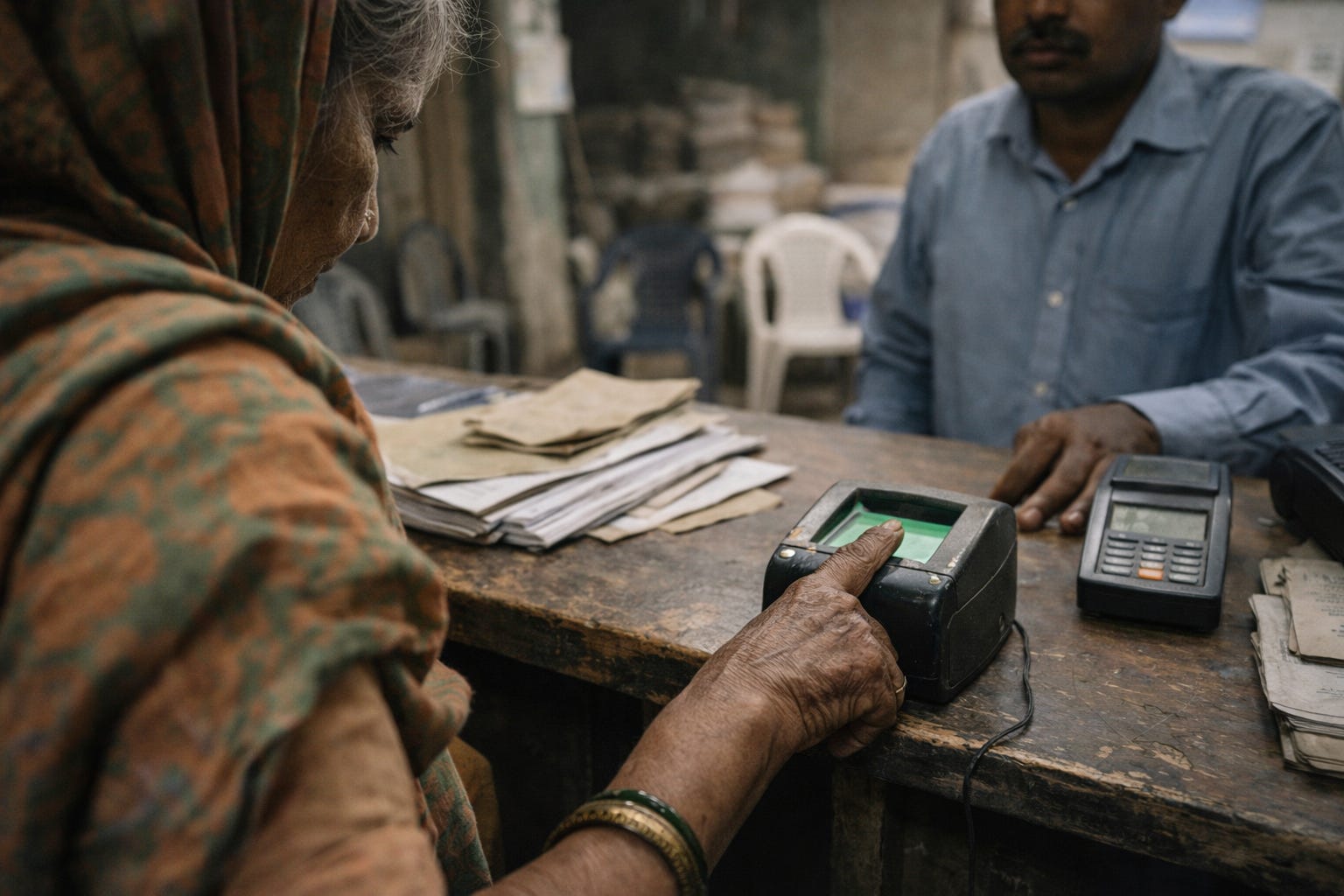
📊 A System Built to Include — That Sometimes Locked People Out
Over the last decade, digital identity has been positioned as the foundation of modern governance.
The promise is compelling: eliminate fraud, reduce leakage, and ensure benefits reach the right people at the right time.
India’s Aadhaar program became the global symbol of that vision—the world’s largest biometric identity system, covering more than a billion people and powering everything from welfare delivery to banking access.
But when identity infrastructure becomes mandatory for accessing essential services, system failures stop being technical glitches.
They become questions of rights, dignity, and survival.
In parts of India, Aadhaar-linked authentication failures meant something simple and devastating:
No scan. No rations.
No authentication. No pension.
No database match. No welfare access.
This was not a failure of scale.
It was a failure of the system design to meet real-world inequality.
📖 When a Digital Cure-All Meets Human Reality
Aadhaar was built to solve a real problem — leakages in welfare systems and ghost beneficiaries. The system promised massive efficiency gains and fraud reduction.
But the policy framing carried a hidden trade-off:
Prevent fraud, even if it excludes some genuine beneficiaries.
Over time, this logic shaped implementation choices:
Biometric authentication became mandatory.
Exception handling remained weak in practice.
Infrastructure assumptions did not match ground realities.
In policy terms, efficiency quietly began competing with universality.
And for some citizens, universality is lost.
🎥 Explainer: Aadhaar, Welfare Access, and Algorithmic Exclusion
[Aadhaar Exclusion Explainer Video]
🔍 The Real Failure Was Not Technical — It Was Structural
Most debates about digital identity focus on:
Data security
Privacy
Surveillance
Technology architecture
All important.
But Aadhaar exposed a different risk:
What happens when access to rights depends on perfect system performance?
Biometrics fail.
Connectivity fails.
Data gets corrupted.
Records mismatch.
In high-capacity urban systems, these are inconveniences.
They can have disastrous effects in settings where people rely on welfare.
If a person must authenticate digitally to receive food or pensions, then system uptime becomes a social justice issue.
🌍 Why This Matters Far Beyond India
India is now exporting digital public infrastructure globally — and rightly so in many contexts. But Aadhaar’s early exclusion episodes offer critical lessons for any country building population-scale digital identity.
In many Global South contexts:
Documentation gaps are common.
Digital literacy varies widely.
Connectivity is uneven.
Biometrics deteriorate with manual labour and age.
When digital identity becomes the primary gateway to state services, system design choices determine who remains visible—and who disappears from it.
Automation does not remove inequality.
It can be make it systematic.
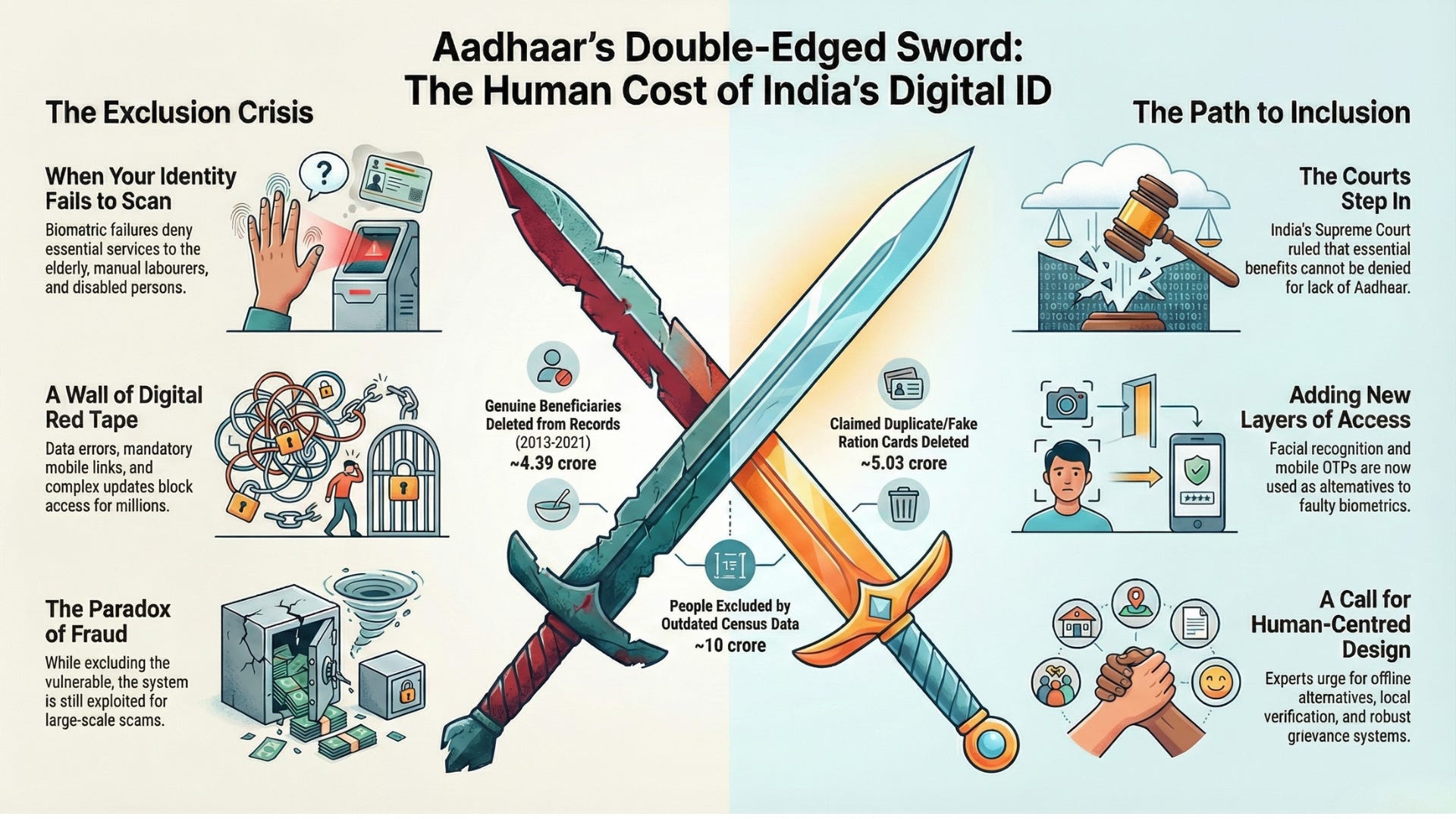
👉 In the Full Analysis
We break down:
How fraud-prevention framing shaped system objectives
Why biometric reliability varies across populations
How lifecycle failures compounded exclusion risks
What safeguards governments must build before scaling digital identity
👉 Read the full case analysis here:
[Aadhaar Digital Exclusion case study — globalsouth.ai]
👉 Download the Adhaar Exclusion Case Deck (PDF)
The Real Governance Question
Aadhaar is often described as a technological achievement — and it is.
But it is also a case study in what happens when digital infrastructure moves faster than institutional safeguards.
When access to rights hinges on system verification, technology ceases to function as administrative infrastructure.
It becomes a gatekeeper of citizenship and survival.
If you work on digital identity, welfare technology, AI governance, or public infrastructure design, this is not just an India story.
It is an early signal of the choices every digitisation state will eventually face.