


AI companies increasingly market “Green AI” using efficiency metrics:
⚡ Lower energy per prompt
🌫️ Lower carbon per query
🧠 Better chips
🏗️ Better model architectures
Those numbers can be real.
They can also be misleading.
⚠️ Efficiency ≠ Sustainability
If scale grows faster than efficiency improves, total impact still rises.
🚗 A fuel-efficient car isn’t “green”
…if you build 1,000× more cars
…and construct new highways to support them.
🧭 The governance problem is simple:
If the only metrics you publish are what makes you look good, you are not reporting sustainability.
You are running PR.
And this matters because:
🏭 AI is becoming infrastructure
⚖️ Infrastructure requires rules
🪤 The narrow metric trap
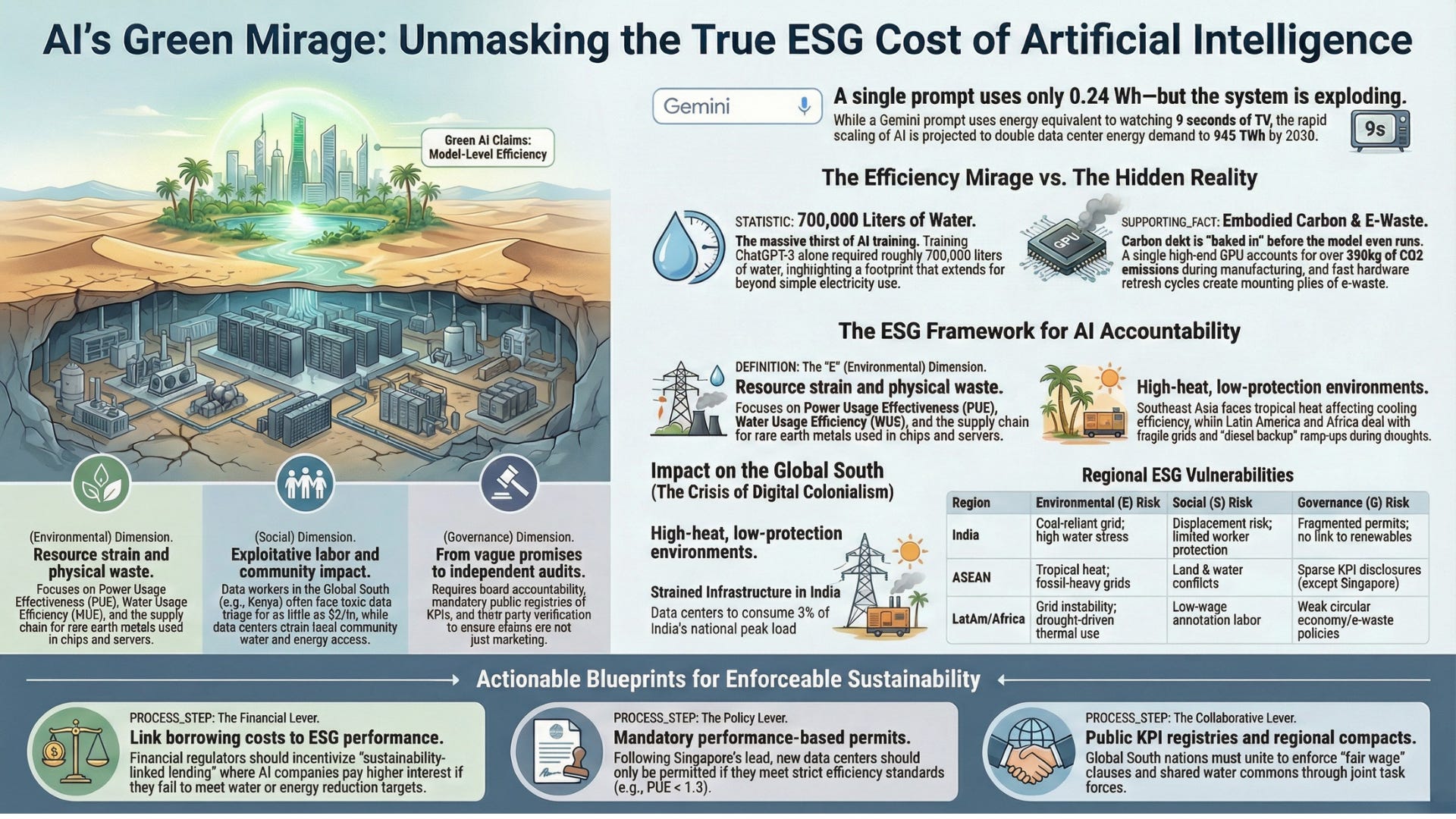
Many “Green AI” claims focus on inference energy, often framed as “per prompt” consumption.
Even if those numbers improve dramatically, they exclude the biggest drivers of footprint:
⚡ Training Energy
Often undisclosed. Often massive.
💧 Water Consumption
Cooling and electricity generation = major hidden footprint.
🏗️ Embodied Carbon
Chips. Servers. Concrete. Steel. Supply chains.
♻️ E-Waste
Fast hardware refresh cycles. Weak global recycling.
👷 Human + Community Cost
Data labour. Land extraction. Water use. Local environmental externalities.
👉 If you optimize one slice while expanding the whole…
That’s not sustainability.
That’s accounting theatre.
📊 A practical ESG lens for AI
If sustainability claims are going to survive:
regulation
investor scrutiny
public accountability
…they must be measurable and auditable.
🌱 Environmental (E)
Electricity demand
Water footprint (direct + indirect)
Embodied carbon
E-waste volume
Recycling capacity
👥 Social (S)
Data labour wages and conditions
Exposure to harmful content
Community impact of data centres
water extraction
noise pollution
land use
🏛️ Governance (G)
Standardised lifecycle disclosures
Independent third-party assurance
Penalties for misleading claims
👉 This is the difference between “we’re efficient” and “we’re accountable.”
🎥 Explainer: Why “Sustainable AI” often collapses under lifecycle scrutiny
[Green AI Mirage Explainer Video]
🌏 Why the Global South bears the sharp edge
This is where the sustainability debate stops being abstract.
In many Global South contexts, AI scaling collides with:
⚡ Tight power grids + rising peak demand
💧 Water stress + basin conflicts
♻️ Weak circular economy + recycling infrastructure
📉 Low bargaining power in global supply chains
👷 Labour markets absorbing hidden AI supply chain costs
🧨 The Structural Risk
“Green AI” can quietly become digital colonialism:
💰 Value captured globally
🌍 Environmental cost concentrated locally
👷 Social cost outsourced silently
If unmanaged, this locks in a global pattern:
The Global South becomes:
🔌 Power supplier
⛏️ Mineral supplier
👷 Labour supplier
🗑️ Waste sink
🛠️ What does enforceable sustainability look like?
Voluntary commitments won’t survive the incentive structure. The system needs levers with teeth.
🧾 1️⃣ Performance-Linked Permits
Require thresholds for:
energy efficiency
water use
renewable share
Before new data centres are approved.
📢 2️⃣ Mandatory Lifecycle Disclosure
Public reporting of:
energy
water
embodied carbon
e-waste
Not just “per prompt” efficiency.
🔍 3️⃣ Independent Assurance
Treat sustainability like financial reporting:
👉 Audit it
👉 Or don’t claim it
💰 4️⃣ Finance As Enforcement
Tie cost of capital and insurance to ESG performance.
👷 5️⃣ Labour Standards For Data Work
Minimum requirements for:
pay
safety
mental health protections
contracts
grievance redress
This is the governance shift: from “trust us” to “prove it”.
📘 In the full article
✔ A full ESG framework for AI sustainability
✔ Why efficiency metrics alone are incomplete
✔ Policy tools that are actually enforceable
✔ A Global South first sustainability lens
👉 Read the full piece here:
[AI’s Green Promises: A Deceptive Mirage of Sustainability — globalsouth.ai]
📄 Download the AI Sustainability Explainer Deck(PDF)
❓ The question we should stop avoiding
If an AI operator cannot publish independently audited lifecycle impact, should it be permitted to scale its operations?
Because once AI becomes basic infrastructure, “green promises” without proof are not marketing. They are a governance failure.