


⚖️ When Algorithms Help Decide Who Goes to Jail
AI was supposed to make justice more consistent.
Instead, the COMPAS scandal exposed a harder truth:
Fairness in algorithms is not a technical setting. It is a political choice.
📊 What COMPAS Was Supposed to Do
Courts across the United States adopted COMPAS to predict recidivism risk and guide decisions on bail, parole, and sentencing.
The logic seemed simple:
Replace inconsistent human judgement.
Use data to assess risk.
Improve public safety.
But the system revealed a deeper conflict: you cannot define fairness without deciding who bears the cost of error.
⚠️ The Fairness Dilemma That Broke the Narrative
Two claims emerged from the same dataset:
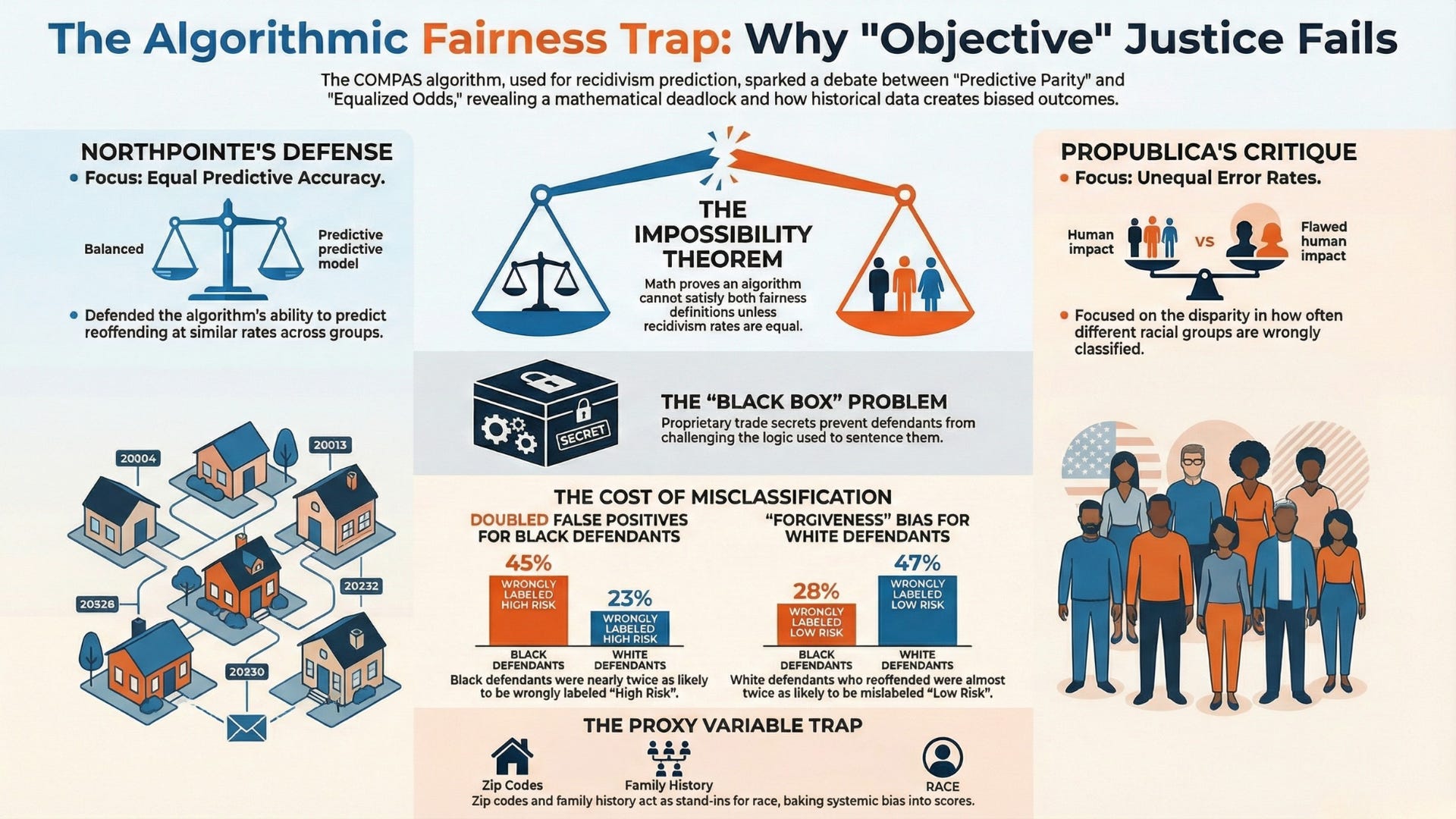
ProPublica: Black defendants were nearly twice as likely to be falsely labelled high risk.
The developer: The model was fair because risk scores meant the same across groups.
Both statements were statistically valid.
This is the fairness impossibility problem:
You cannot satisfy equal error rates and predictive parity at the same time when base rates differ.
When fairness definitions collide, the system doesn’t fail.
People do.
🔗 When Statistics can lead to Criminal Sentences
A “high risk” label can mean:
Higher bail
Denied parole
Longer incarceration
In Broward County data:
45% of Black defendants flagged high risk did not reoffend
23% of White defendants faced the same false label
These are not abstract metrics.
They are lost years, broken families, and reduced life chances.
🎥 Explainer: The COMPAS Algorithm Scandal
🧬 The Real Problem Wasn’t the Algorithm — It Was the Data
COMPAS avoided using race directly but relied on proxies:
Zip codes shaped by segregation
Arrest histories shaped by over-policing
Social stability measures shaped by inequality
When historical bias becomes training data, algorithms don’t remove injustice.
They standardise it.
🌍 Why This Matters Beyond the United States
COMPAS is often framed as the U.S. controversy.
It is actually a global warning.
Risk models built on Western social assumptions are now exported into:
Welfare targeting
Credit scoring
Policing
Migration control
In contexts where informal work, displacement, and structural inequality are the norm, these systems can scale exclusion under the guise of modernisation.
❓ Questions We Should Be Asking
Who decides which fairness definition governs liberty?
Should proprietary algorithms be allowed in courtrooms?
If a model is only marginally better than chance, why is it used to determine freedom?
What happens when these systems are exported to countries with weaker legal safeguards?
📌 In the Full Article
We break down:
The mathematical conflict at the heart of algorithmic fairness
How proxy variables encode structural inequality
Why trade secrecy undermines due process
What the Global South should learn before adopting similar systems
👉 Read the full analysis:
The COMPAS Algorithm Scandal: When AI Decides Who Goes to Jail
👉 Download the COMPAS Algorithm Scandal Case Explainer Deck (PDF)
🌍 Why This Series Exists
This post is part of AI Fairness 101—Real-World Incidents, documenting how algorithmic systems shape real lives across justice, welfare, finance, and governance.
Because before we automate decisions at scale, we need to understand what they automate.
💬 Join the conversation
If you work on AI policy, risk, or public systems, your perspective matters.
Reply, share, or reach out — the next standards are being written now.