


The global AI fairness conversation is shifting.
Not because bias disappeared.
Because the definition of fairness itself is being rewritten.
And if the Global South does not respond, someone else will define fairness for it.
🎥 Explainer: Global South Fairness Response to the US AI Action Plan
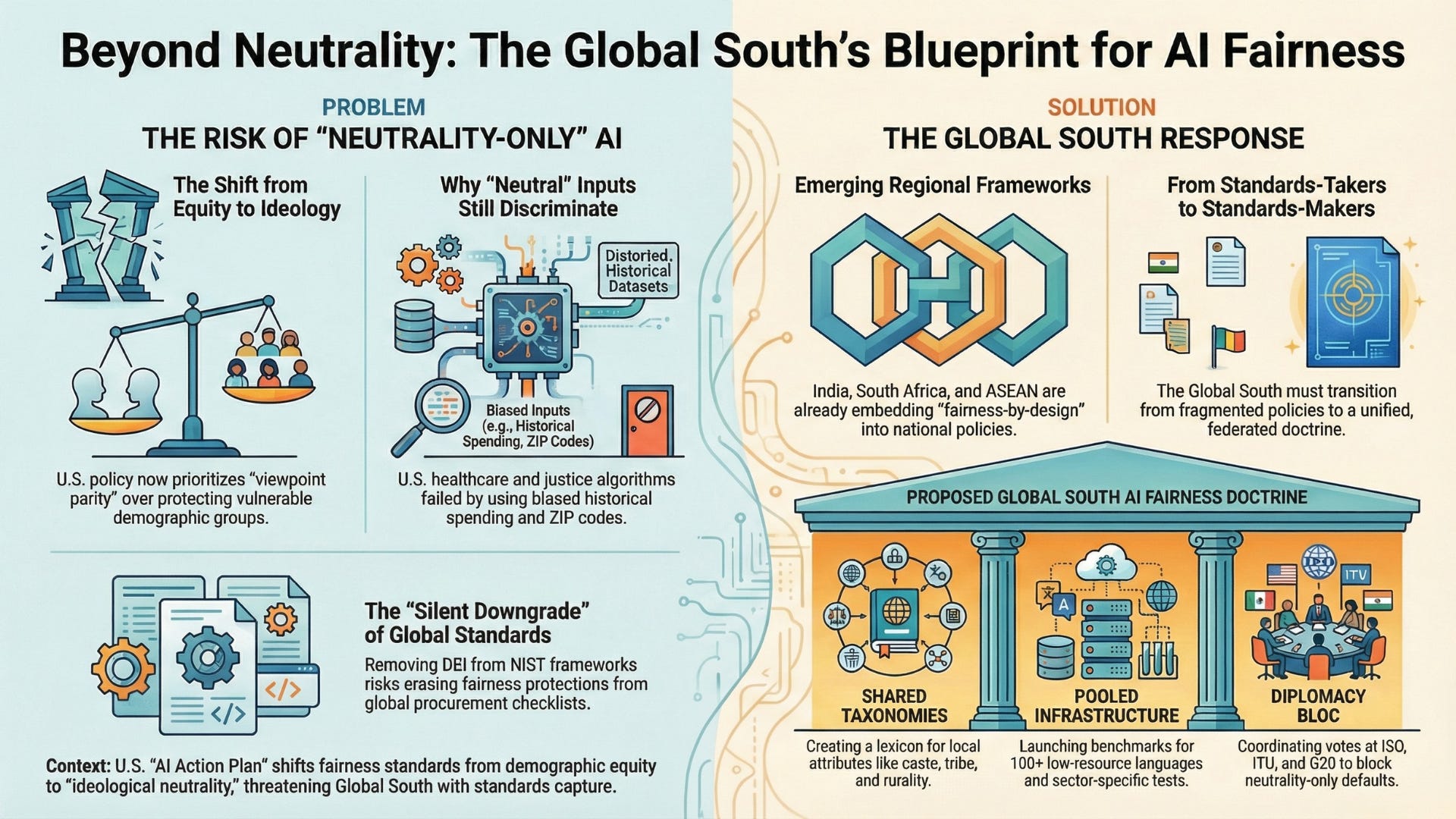
🧠 What Actually Changed
The new policy direction reframes fairness.
From:
✔ measurable demographic outcomes
✔ statistical bias detection
✔ real-world harm reduction
To:
➡ ideological neutrality
➡ viewpoint balance
➡ narrative symmetry
That sounds neutral.
But neutrality without structure usually preserves historical inequality.
⚠ The Real Danger: Standards Capture
When major economies redefine fairness, it rarely stays local.
It travels through:
procurement standards
technical frameworks
global certifications
vendor compliance baselines
If exported globally, this creates a silent downgrade in safety.
Not because systems become malicious.
Because they stop checking for real-world exclusion.
🪔 Why This Hits the Global South Harder
Fairness is not abstract in the Global South.
It is structural.
AI interacts with:
caste and tribal hierarchies
extreme language fragmentation
informal labour markets
regional educational inequality
rural vs urban opportunity gaps
If fairness becomes ideological neutrality only, those realities disappear from audits.
The model can pass compliance while still denying credit, jobs, or welfare to vulnerable groups.
📉 The Neutrality Mirage
History shows “neutral” systems reproduce biased histories.
Examples globally already proved this:
healthcare allocation bias
predictive policing bias
credit scoring proxy discrimination
Removing demographic fairness checks does not remove bias.
It removes the tools used to detect it.
🌐 The Strategic Pivot Already Happening
The Global South is not waiting.
Different regions are building sovereign fairness approaches:
🇮🇳 India → Constitutional anti-discrimination + fairness-by-design
🇿🇦 South Africa → Historical justice safeguards
🇧🇷 Latin America → Human-centred AI + impact assessments
🌏 ASEAN → Cooperative, inclusion-focused digital governance
This is not fragmentation.
This is pluralistic global governance.
🧭 The Strategic Opportunity
For the first time, the Global South can move from:
Standard Taker → Standard Co-Author
But only if it coordinates.
Fragmented national responses cannot counter global platform power.
📜 What a Global South Fairness Doctrine Could Look Like
Not ideology.
Not Western replication.
But enforceable, local-reality fairness.
Possible pillars:
• Shared fairness taxonomies (caste, tribe, dialect, rurality)
• Shared benchmark datasets for low-resource languages
• Joint standards voting blocs
• Shared compute + fairness testing infrastructure
• Procurement rules requiring subgroup performance transparency
This is how values become market power.
📘 In The Full Article
We break down:
• Why ideological neutrality fails mathematically and legally
• How standards capture happens through technical supply chains
• What a real Global South fairness doctrine could look like
• How countries can coordinate without losing sovereignty
👉 Read Full Analysis:
[Beyond America’s AI Action Plan: A Global South Response on Fairness]
👉 Download the America’s AI Action Plan and Global South Explainer Deck (PDF)
💭 The Question The Global South Cannot Avoid
If fairness standards are written without your social reality in scope…
Are you governing AI?
Or importing someone else’s definition of justice?