

The NIST AI Risk Management Framework is increasingly treated as a global blueprint for “trustworthy AI.”
But global frameworks travel faster than the capacity to implement them.
And that gap matters.
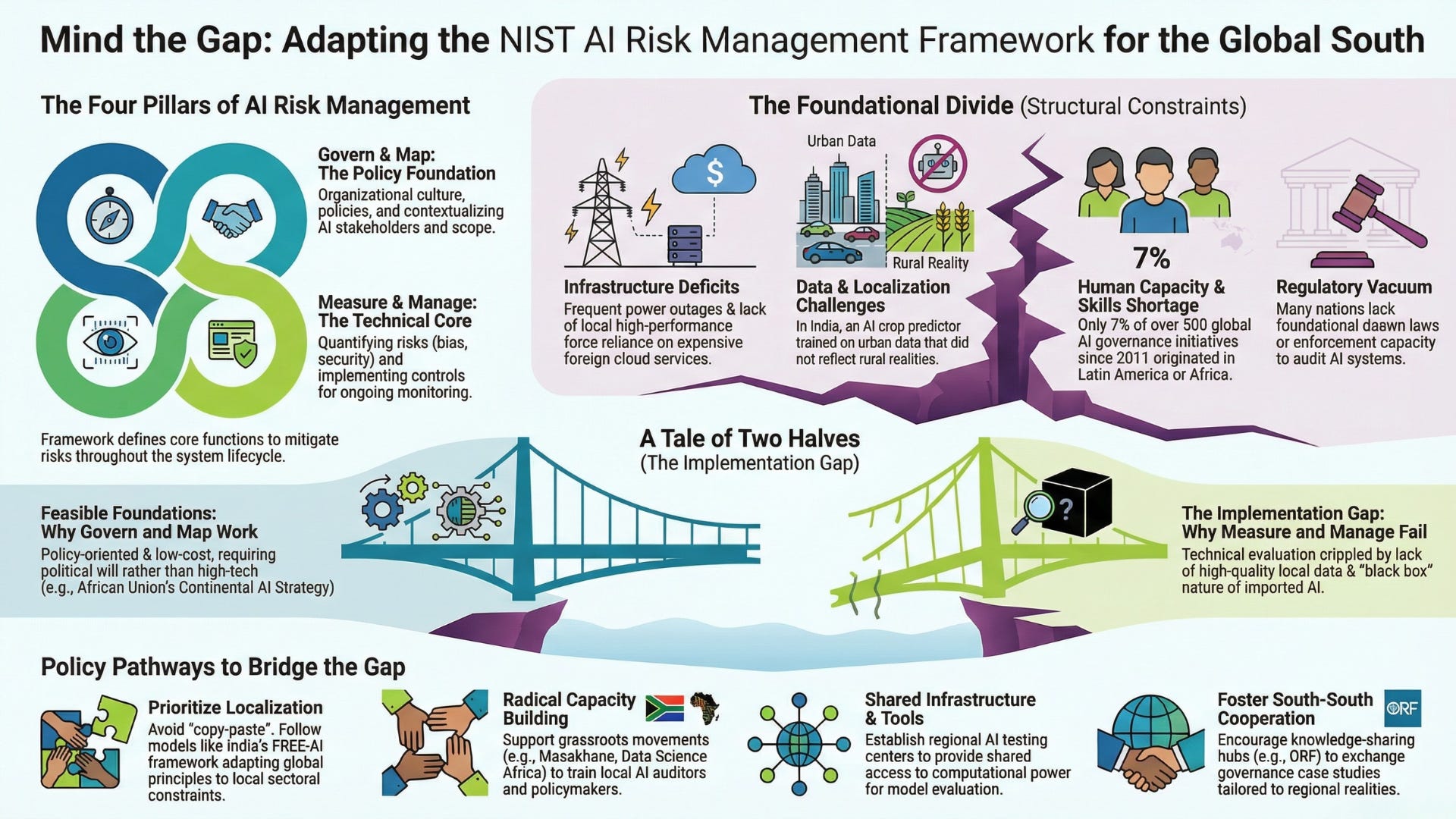
🎥 Explainer: NIST AI Risk Framework and the Global South
🧠 The Problem Isn’t The Framework
The NIST AI RMF is structurally strong.
The challenge is context.
It assumes:
stable infrastructure
strong regulatory institutions
deep audit ecosystems
high-quality local data
abundant technical talent
Those conditions are not universal.
⚠ The Risk Nobody Talks About: “Missed Use”
In advanced economies, the concern is misuse of AI.
In many Global South contexts, the greater risk lies in not deploying AI where it is urgently required.
Food systems. Public health. Financial inclusion. Climate resilience.
Governance can block progress if it assumes capacity that does not exist.
🔌 Governance Starts With Infrastructure
Risk measurement requires compute, stable power, and reliable data pipelines.
Many regions still face:
unstable grids
limited connectivity
dependence on foreign cloud infrastructure
fragmented public datasets
If you cannot measure risk locally, you cannot manage it meaningfully.
👩💻 The Talent Reality
Risk frameworks assume auditors, regulators, and technical reviewers exist at scale.
The reality is that a few regions heavily concentrate AI governance talent.
The result is often policy adoption without enforcement capacity.
⚖ Where The Framework Actually Splits
Govern and Map are feasible starting points.
They depend on policy coordination and institutional design.
Measure and Manage are harder.
They require infrastructure, data maturity, and technical autonomy.
Without those, risk management becomes symbolic.
🌐 The Strategic Danger
You don’t get zero governance.
You get half governance:
The policy structure lacks technical control.
That creates long-term dependency on external infrastructure, tools, and validation ecosystems.
🧭 The Real Goal: Adaptation, Not Rejection
The Global South does not need to reject global frameworks.
It needs to adapt them.
That means:
localising “trustworthy AI” definitions
building local audit and regulatory talent
investing in shared regional testing infrastructure
strengthening South–South collaboration
The goal is not fragmentation.
It is sovereign interoperability.
📘 Read The Full Article
Where we break down:
• Where NIST RMF works globally
• Where it structurally breaks under capacity constraints
• How Global South countries can adapt it intelligently
👉 Read Full Analysis:
[Mind the Gap: Why the NIST AI Risk Framework Breaks Down in the Global South]
👉 Download the NIST AI RMF and Global South Explainer Deck (PDF)
💭 The Question Policymakers Should Ask
If your AI risk framework depends on infrastructure, data, and audit capacity you do not control…
Is that governance?
Or compliance outsourcing?