


🧠 Big idea: The EU AI Act is a landmark. But it’s also a product of Europe’s environment. Exporting it “as is” can create an operating system mismatch for much of the Global South.
🔎 The problem isn’t the EU AI Act
The problem is uncritical transplantation.
The EU AI Act was designed for:
data-rich environments
mature institutions and auditors
strong enforcement capacity
a rights jurisprudence shaped by Europe’s own history
Those are not universal conditions.
So when Global South governments or companies adopt EU-style compliance without adaptation, the result is often:
✅ paper compliance
❌ stalled innovation
❌ higher costs for local startups
❌ more dependence on foreign vendors
In short: regulation meant to protect people can unintentionally price out local solutions.
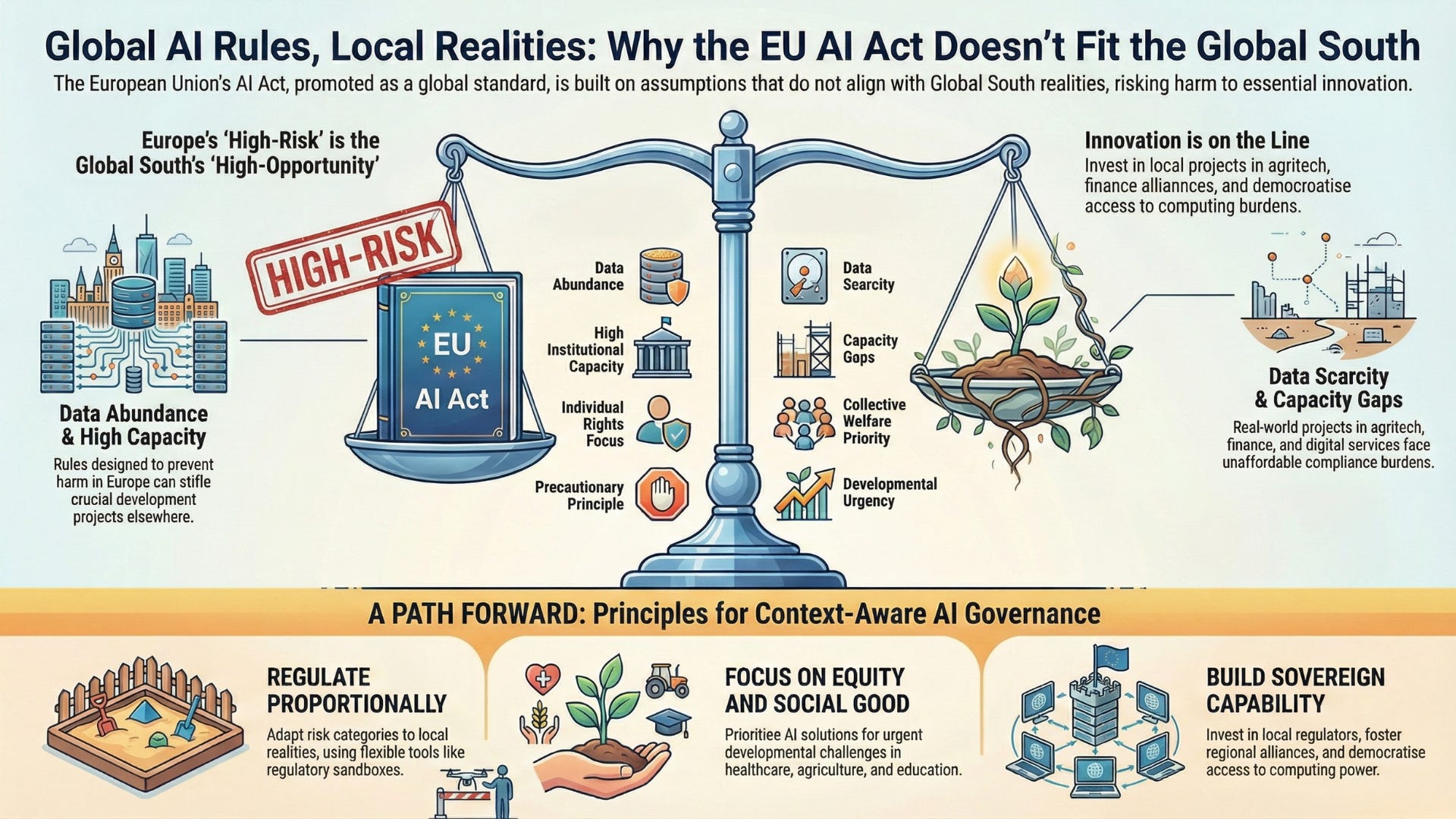
🧩 Four hidden assumptions that don’t travel well
Every regulation embeds assumptions about its “home terrain”. Here are the four that matter most:
📚 1) Data abundance vs data scarcity
EU-style documentation assumes clean datasets and traceable provenance. Many Global South deployments rely on messy, incomplete, scraped, or informal data. Compliance becomes a tax on scarce capacity.
🏛️ 2) Institutional maturity vs capacity gaps
Risk audits and conformity assessments require trained auditors, budgets, and enforcement machinery. Without them, you either get symbolic checklists or market exit for small players.
👥 3) Individual rights lens vs collective welfare priorities
Rights protections matter everywhere. But many societies also weigh community benefit, developmental urgency, and inclusion differently. A single yardstick can misread what “responsible” looks like on the ground.
⏳ 4) Precautionary principle vs developmental urgency
In contexts where delayed deployment can cost lives or livelihoods, “wait until everything is certified” can be its form of harm.
➡️ Bottom line: what looks like safety in Brussels can look like a brake on survival elsewhere.
⚠️ “High risk” in Europe can be “high opportunity” in the Global South
Here’s the tension policymakers must face:
🟠 In Europe, certain systems are labelled high risk to prevent harms.
🟢 In the Global South, those same systems are often high-opportunity pathways to inclusion.
A few examples (you’ll recognise the pattern):
🗣️ Language inclusion platforms that need speed and openness
🌾 Agritech tools built by small innovators who can’t afford heavyweight audits
🪪 Digital identity systems where delays mean continued exclusion
💳 Alternative credit scoring that can expand access to finance but gets labelled high risk by default
If you import categories without context, regulation stops managing risk and starts reallocating market power.
🎥 Explainer: Beyond the Brussels Effect
[EU AI Act & Global South Video]
🌍 The geopolitics layer: “standard takers” vs “standard makers”
The EU’s market power creates a real dynamic: if you want access, you often align.
That’s not inherently bad. But it becomes dangerous when Global South countries end up as rule adopters without being rule authors.
📌 The risk: regulatory monoculture
When one governance model dominates globally, local experimentation and “digital biodiversity” shrink.
And that can produce a subtle form of dependency:
only large firms can afford compliance
local startups struggle to compete
governments import standards without the enforcement capacity to apply them meaningfully
🛠️ A better path: a “gold spectrum”, not a single gold standard
This isn’t an argument for deregulation. It’s an argument for pluralistic governance.
✅ Keep the EU Act’s spirit (risk-based oversight)
🔁 Adapt the categories and requirements to local realities
📈 Phase in compliance as capacity grows
🤝 Build regional coalitions so the Global South negotiates as a bloc, not as isolated states
🧮 Treat compute equity as a governance prerequisite (compliance costs compute too)
🗝️ The goal: sovereign interoperability
Rules that communicate globally but are grounded locally.
👉 In the full piece
I unpack the full framework:
Show how the mismatch plays out across data, institutions, values, and urgency, and
Propose a practical path forward for Global South governments to become co-authors of global AI governance rather than passive recipients.
🔗 Read the full analysis here:
[When Good Intentions Go Global: Why the EU AI Act Doesn’t Fit the Global South]
📄 Download the EU AI Act and the Global South Explainer Deck (PDF)
🧭 Closing thought
The future of AI governance cannot be a monologue exported from one region to the rest.
It has to be a conversation among equals.
Because in a world shaped by algorithms, context is not a footnote. It is the foundation.